
by Dpa
edited by Sadie Harley, reviewed by Andrew Zinin
Add as preferred source
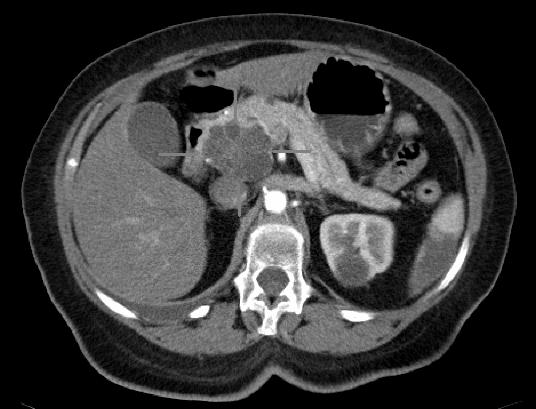
Axial CT image with i.v. contrast. Macrocystic adenocarcinoma of the pancreatic head. Credit: public domain
Your pancreas has important jobs to do. A large gland behind the lower part of the stomach, it produces hormones that regulate blood sugar and enzymes that help digest food. What if it develops cancer?
A diagnosis of pancreatic cancer is a huge shock for the affected person and their loved ones in view of the low survival rate; “90% die within five years,” says Lutz Otto, chairman of Germany’s Association of Pancreatectomized Patients (AdP), ie. having had all or part of their pancreas surgically removed.
As with other types of cancer, the earlier that pancreatic cancer is detected, the better the chances of successful treatment. But in contrast to breast or colon cancer, for instance, there’s no widely accepted screening procedure for early detection.
The tumor grows slowly, often causing no or only vague symptoms until the cancer has spread to other organs. So it’s all the more important to heed the possible signs and symptoms when they arise. These include:
- chronic upper abdominal pain, often described as dull and deep
- unexplained back pain
- nausea and vomiting, which can occur if the tumor constricts the duodenum or pylorus (the former being the part of the small intestine immediately beyond the stomach, and the latter the opening from the stomach into the duodenum)
- diabetes, which can appear a year or two before other symptoms
- jaundice—marked by yellowing of the skin and whites of the eyes—if the tumor blocks the liver’s bile duct
- stool that is light-colored and greasy, sticky or shiny, according to the Cancer Information Service at the German Cancer Research Center (DKFZ)
- unexplained weight loss or loss of appetite
- increased tiredness or weakness
- night sweats
- a palpable abdominal mass
If such signs and symptoms as these arise without a clear cause, or persist for around two to four weeks, the DKFZ advises seeing a doctor.
People with a heightened risk of pancreatic cancer should be especially alert to the warning signals. This applies, for example, to people with at least two first-degree relatives—parents, siblings or children—with the disease, the DKFZ says.
They would be well advised to undergo imaging, such as MRI (magnetic resonance imaging) or endoscopic ultrasound, ideally at a university hospital’s pancreatic cancer center.
Having a family history of the disease isn’t the only risk factor, however. Others include smoking, obesity and drinking a lot of alcohol.
Key medical concepts
Carcinoma, PancreaticMagnetic Resonance ImagingEndoscopic UltrasonographiesDiabetesObesity
Clinical categories
OncologyCommon illnesses & PreventionGastroenterologyDigestive health
2026 dpa GmbH. Distributed by Tribune Content Agency, LLC.
Explore further
Q&A: Pancreatic cancer risk, symptoms and treatment