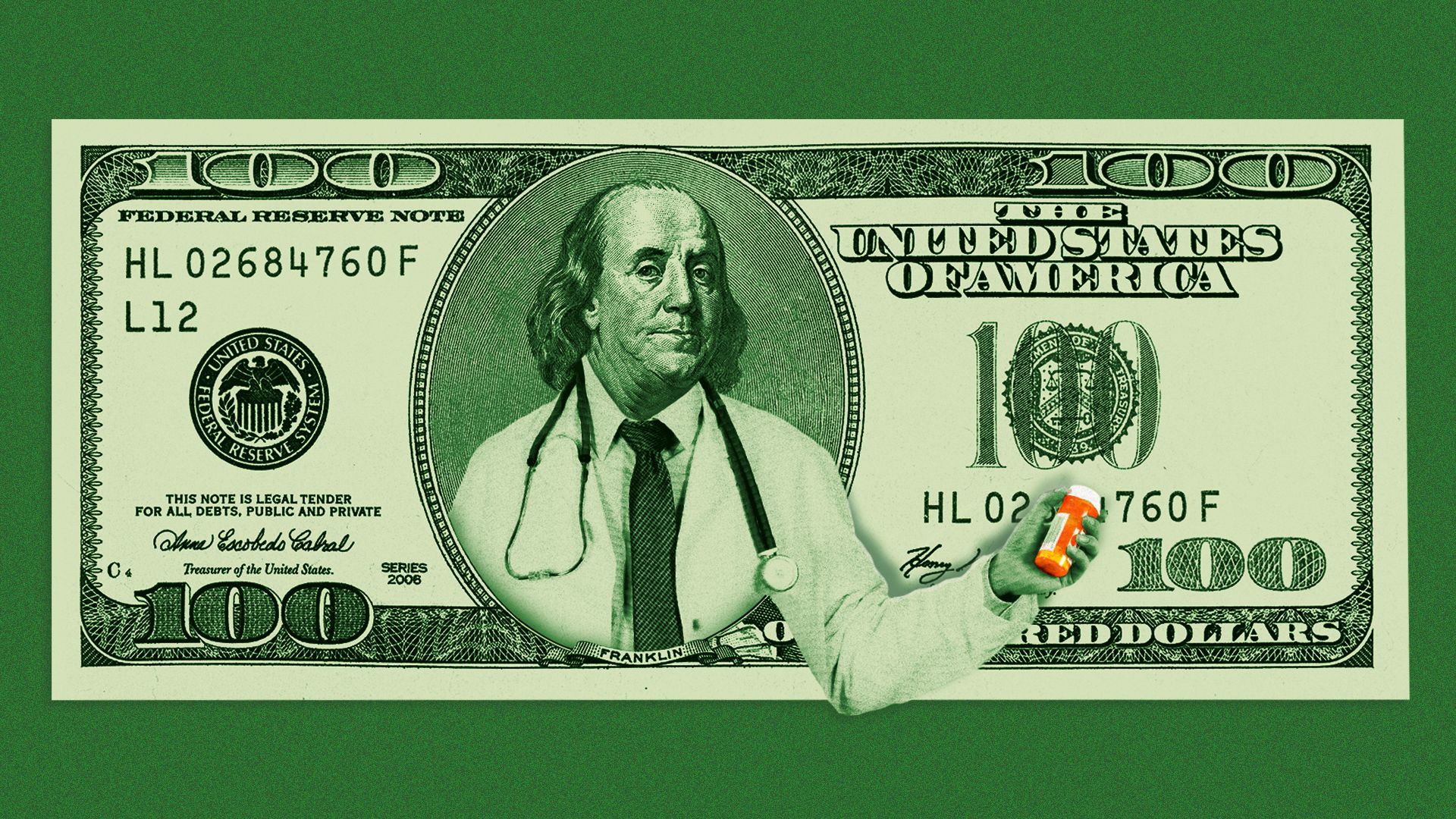
| The Trump administration on Friday finalized a controversial plan to reevaluate how Medicare calculates doctor payments that will result in lower rates for specialty services.
Why it matters: Medicare will implement a 2.5% cut next year to payments for services like radiology and gastroenterology that are based on more than time spent delivering the service.
Catch up quick: The rule is based on the CMS argument that these procedures and tasks are being done more efficiently than the old payment rate reflects.
- Meanwhile, primary care doctors and other providers will generally see an increase in their Medicare payment next year.
- The rule moves Medicare away from setting billing code reimbursement based on surveys by an American Medical Association-affiliated committee that ask providers about the time, intensity and expense of different medical services.
What they’re saying: The change is an “important step to address methods that have long diverted funding away from the whole-person, relationship-based primary care Americans need,” Ann Greiner, CEO of the Primary Care Collaborative, said in a statement.
The other side: Specialists say the policy devalues their work and could result in worse care for patients.
- “These reductions to physician work ignore the realities of modern medicine, including rising patient complexity and evolving technologies that demand more from physicians, not less,” Qihui Zhai, president of the College of American Pathologists, said in a statement.
Read more
|
😳 Obamacare sticker shock after the subsidies expire will depend on where people live, how heavily their premiums have been subsidized and what their income is. (Politico)
💰 At least 31 states have enacted laws this year intended to lower drug costs, and nearly two-thirds are aimed at pharmacy benefit managers. (Stateline)
💊 The Health Resources and Services Administration has approved nine drugs to test a new rebate model for the 340B drug discount program. (The Pharma Letter)
from STAT:
CANCER
Caribou’s off-the-shelf CAR-T therapy shows promise
Caribou Biosciences said this morning that its off-the-shelf CAR-T therapy induced complete and durable remissions in patients with advanced B-cell lymphoma.
The study results, while preliminary, are comparable to benchmarks set by currently approved, patient-specific CAR-T therapies for lymphoma — an achievement that could push the off-the-shelf CAR-T field forward after years of setbacks and broaden access to cell therapy for blood cancers, STAT’s Adam Feuerstein reports.
“We have long believed that an allogeneic [off-the-shelf] CAR-T could drive outcomes like an autologous [patient specific] CAR-T,” Caribou CEO Rachel Haurwitz said. “Whether you look at overall response rate, complete response rate or progression-free survival, vispa-cel looks exactly like Yescarta or Breyanzi.”
|
FDA’s Q-Collar authorization exposes transparency gaps
The FDA’s authorization of the Q-Collar — a neck device marketed to “protect the brain” — reveals troubling gaps in regulatory transparency, opines Tufts professor James Smoliga. He argues that FOIAed internal memos show FDA reviewers doubted the device’s evidence base, yet authorization through the de novo pathway allowed it to be marketed as safe despite inconclusive data.
Smoliga warns that the “FDA authorized” label misleads consumers into assuming proof of effectiveness, fueling a $200 false sense of security for athletes and parents alike. He says that genuine transparency in the de novo process would involve publication of reviewer memos, plain-language labeling that distinguishes “authorized” from “proven,” and clearly stating how confident regulators are in the evidence.
“This is not just about one device,” he writes. “It’s about what happens when institutions grow comfortable living in their own ambiguity and hiding behind opacity.”
Read more. |
|