cancer
A hidden cancer target turns up outside cells
There’s something rather strange — and potentially useful — on the surface of cancer cells: Src, a famous cancer-driving protein that is supposed to live inside the cell. UCSF researchers have found that in malignant cells, dysfunctional lysosome recycling can cause Src to end up stuck on the outside of the cell membrane. This effectively exposes a classic oncogene to antibody-based therapies that normally can’t reach intracellular targets, STAT’s Angus Chen writes.
Immunotherapies depend on recognizable surface markers, which are plentiful in blood cancers but frustratingly rare in solid tumors. The new findings, published in Science, show that antibodies and a bispecific T-cell engager targeting surface Src could kill tumors — in mice.
But the preclinical promise here is tempered with plenty of questions — including whether the phenomenon occurs in healthy cells, and whether tumors could simply stop displaying the protein. But the work hints at a broader possibility: that other intracellular oncogenes may occasionally be “barfed” outward by stressed cancer cells, creating a new class of druggable immunotherapy targets.
Read more.
from AXIOS:
| How doctors are using AI |
|
 |
|
| Illustration: Lindsey Bailey/Axios |
|
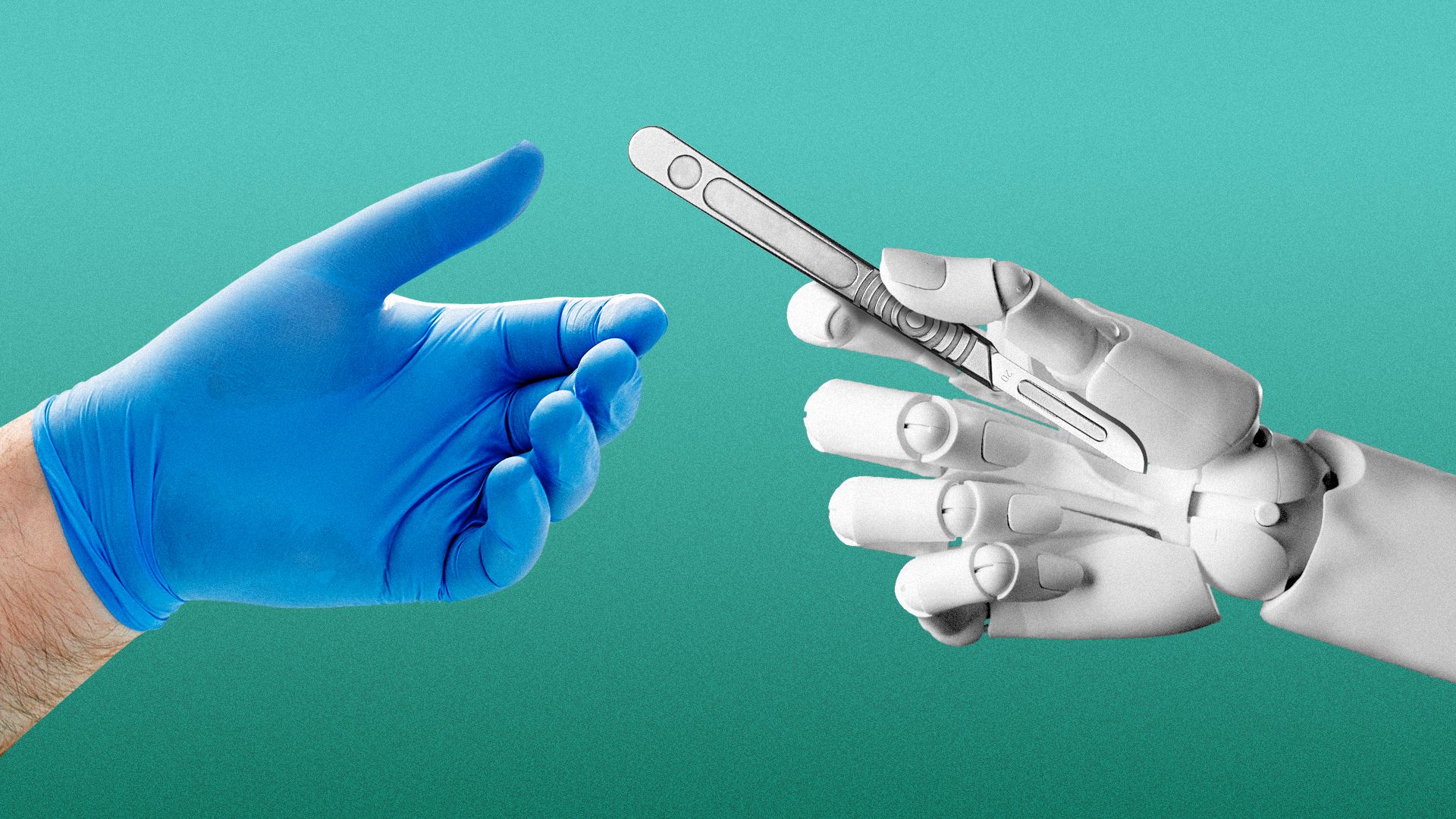
| Doctors are increasingly using generative AI in clinical care, and enthusiasm is building for how the technology could solve deeply entrenched problems.
Why it matters: There’s a wide spectrum of applications — some already widely embraced by the medical establishment, others viewed more skeptically as not ready for primetime or even dangerous.
The intrigue: I talked to several of the same people as I did for last week’s story about patients using AI. Those who sounded bullish last week were even more confident about AI in the hands of licensed professionals.
- “For a physician, I actually think these tools are fantastic because they can help augment what you already know and push you on things, but they don’t replace you — yet,” said Ashish Jha, the Biden administration’s COVID response coordinator and former dean of the Brown University School of Public Health.
Driving the news: Only 19% of physicians aren’t using AI professionally now, according to a new survey released yesterday by the American Medical Association.
- The most common use was to summarize medical research and standards of care, with 70% of respondents saying they’re already using AI that way or planning to in the next year.
- Other top uses are to create discharge instructions and care plans, summarize patient charts and to document billing codes, notes from patient conversations and more.
Between the lines: Today’s uses are primarily about saving doctors time with research and administrative tasks. And that is meaningful amid widespread physician burnout and provider shortages.
- Using the tools to diagnose a condition, create a treatment plan or otherwise direct patient care are promising, but much riskier.
- AI tools flooding onto the health care market aren’t all created equal when it comes to reliability and trustworthiness.
- “There are a number of organizations out there that are doing things in an untrustworthy manner. There are also a ton of organizations out there that are doing a fantastic job,” said Shawn Griffin, president and CEO of URAC, which accredits providers and recently launched an AI program.
- “The problem is you can’t tell everybody who is doing it right,” he added.
Some uses are being framed as downright dangerous, especially in diagnostics.
- “Navigating the AI diagnostic dilemma” was named the number one concern of 2026 by the patient safety organization ECRI and the Institute for Safe Medication Practices.
- “AI systems are only as good as the algorithms they use and the data on which they are trained, and the potential for errors remains a significant concern,” the report warns.
What we’re watching: The less-controversial uses, like AI for administrative tasks, will likely build a case for more disruptive applications down the road.
- “They create a level of trust that is necessary as you move on to more ambitious uses, which will almost inevitably be riskier uses,” said Bob Wachter, chair of the Department of Medicine at UCSF and the author of “A Giant Leap: How AI is Transforming Healthcare and What That Means for Our Future.”
- “It’s hard to change physician behavior. They’re used to doing things a certain way,” AMA CEO John Whyte said.
The bottom line: “I think what we’ll be talking about in terms of AI tools a year from now, two years from now, will be different from what we were talking about end of last year, [or] early this year,” Whyte said. |