
House Speaker Mike Johnson, a Republican from Louisiana, said yesterday that Republicans don’t want to change the Emergency Medical Treatment & Labor Act, which requires hospitals to provide care to anyone experiencing a medical emergency, including immigrants without legal status. It’s the latest comment from a Republican in a week focused on undocumented immigrants and medical care.
One of the most consistent Republican arguments in the government shutdown debate is that the Democrats’ government-funding bill would spend hundreds of billions of dollars providing “free health care for illegals.” (Note: Undocumented immigrants are already prohibited from receiving federally funded health insurance, including Medicaid.) Read more from STAT’s John Wilkerson on where things stand.
trends
More people with psychosis are using cannabis
In states where cannabis has been legalized, people with psychosis are using the drug more and more, according to a study published yesterday in JAMA Psychiatry. Researchers analyzed data from 1,856 adults with a lifetime history of psychosis from a national longitudinal study run by the FDA and the NIH. They found that cannabis use increased by nearly 10% five years after states legalized recreational marijuana use.
While the vast majority of people who use cannabis do not develop psychosis, many studies show a link between cannabis use and increased risk of developing psychosis at an earlier age and with a worse prognosis. And as STAT’s O. Rose Broderick points out, the proliferation of legal cannabis has outpaced the regulation of relevant products. Read more about the research and why it has medical experts worried.
from AXIOS:
Drugmakers aren’t yet in the clear
By Caitlin Owens

Illustration: Aïda Amer/Axios
Drug companies’ increasing willingness to negotiate deals with the Trump administration and voluntarily cut some prices may be making a splash, but the real-world impact will probably be underwhelming.
Why it matters: The pharmaceutical industry’s compromises so far can be best viewed as attempts to avoid tariffs or undesirable regulatory action by the Trump administration. And it’s anyone’s guess as to whether they’ll be successful.
Driving the news: The Trump administration is expected to imminently announce more deals similar to the one it announced with Pfizer last week, but multiple drug companies have already taken nearly identical action on their own.
- The Pfizer deal featured the company’s commitment to President Trump’s “most favored nation” pricing plan on drugs sold to state Medicaid programs and on the cost for newly launched drugs. Pfizer also will participate in the TrumpRx sales portal by offering selected drugs at deep discounts off of list prices.
- Other drug companies have already on their own announced plans to sell drugs directly to patients — the central idea of TrumpRx — and price new drugs the same as in other countries.
- The industry, Pfizer included, has also committed hundreds of billions of dollars to building new manufacturing infrastructure in the U.S.
Between the lines: Drug stocks are up in the wake of the Pfizer announcement, and analysts have been quick to note the many reasons why the changes aren’t expected to eat too badly into profits.
- The Pfizer deal did not directly lower prices in Medicare or private health insurance, where most Americans get their coverage.
- Manufacturers also can charge high U.S. launch prices as long as they don’t charge less in comparable wealthy countries.
Yes, but: Other observers predict the last few weeks have simply been the warmup act — and that the administration is ready to extract more concessions from the companies.
Most Americans unsure about Tylenol warning
By Tina Reed
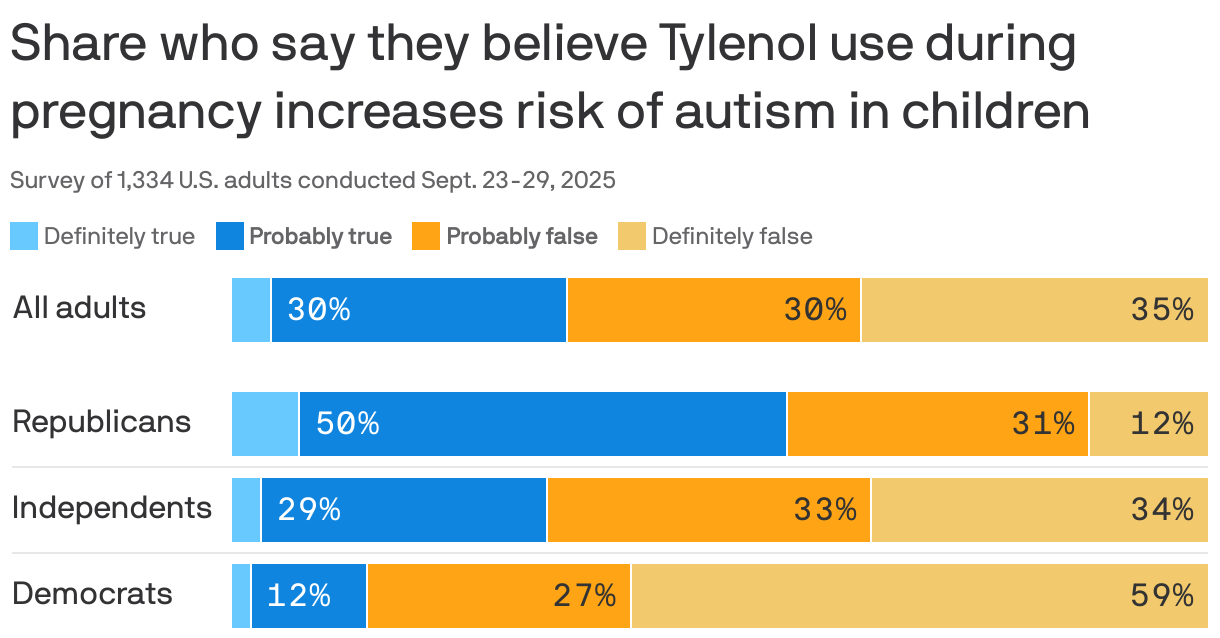
Reproduced from KFF; Chart: Axios Visuals
Most Americans aren’t sure what to make of President Trump’s claim that taking Tylenol during pregnancy can increase the risk of autism in children, but few are accepting it as fact, a new KFF poll finds.
Why it matters: There are deep partisan divisions on the question, just as there are on vaccines, the pandemic response and other health issues.
What they found: Three-quarters of the public (77%) said they had heard the claim, which was aired during a Sept. 22 news conference despite no new evidence of a causal relationship.
- Only 4% of the 1,334 adults polled said it was “definitely true” while a much larger share (35%) said the claim is “definitely false.”
- 60% were unsure, divided roughly evenly between those who said it was “probably true” and others who believe it was “probably false.”
- The partisan splits were significant, with 59% of Democrats saying the claim was “definitely false” compared with 12% of Republicans. Only 2% of Democrats and 3% of independents said the claim was “definitely true.”
Between the lines: The poll indicates eroding trust in health information from officials, with trust in the CDC under Health Secretary Robert F. Kennedy Jr. at its lowest level since the start of the COVID-19 pandemic.
from Endpoint News:
Prescription pick-up
Yesterday, Amazon said it will start setting up machines that can dispense prescription medication at its One Medical clinics.
It’s not a new piece of technology (in fact, it’s basically a vending machine). Some hospitals have similar kiosks for prescription drugs, though they are largely for employees. And CVS Health already sells common over-the-counter drugs like Tylenol the same way.
And while the vending machine concept isn’t new, what it says about Amazon’s strategy is. It’s the complete opposite of what its more traditional pharmacy competitors have done. While CVS and Walgreens began as pharmacies that bought clinic chains, Amazon will start by putting its machines at One Medical locations to offer prescriptions right after appointments.
Amazon now has one more incentive to steer patients toward its own drug channel. Patients can still choose to pick up their medicine elsewhere, but it’s hard to argue with the convenience of having it right in the office, or to get it online from Amazon Pharmacy. Owning multiple channels of healthcare revenue isn’t new, but incentives can muddy now that Amazon can profit twice, president of 3 Axis Advisors Antonio Ciaccia told me.
“Vertical integration presents a blurring of the lines of what we typically might consider to be two components of the marketplace that are distinct from one another,” he said. “There are a lot of ways that this kind of foot-in-the-door in front of competitors can be very advantageous for Amazon as a broader company.”
Data has also shown that people have by and large returned to brick-and-mortar local pharmacies after the pandemic, partly out of habit, Ciaccia said. This appears to be Amazon’s way into having an in-person pharmacy presence.
Amazon’s machines, which include a screen for teleconsults with pharmacists, will start being available across Los Angeles clinics this December. I’ll be keeping an eye on how the technology rolls out beyond that and how effective it is at getting more people to use Amazon Pharmacy.
