
F. Perry Wilson, MD, MSCE
DISCLOSURES November 05, 2025
Welcome to Impact Factor, your weekly dose of commentary on a new medical study. I’m Dr F. Perry Wilson from the Yale School of Medicine.
The use of doxycycline in childhood may protect against the future development of schizophrenia.
Wait… what?
This is a little “how the sausage gets made,” but to write this column every week I read through dozens of medical studies that have just come out looking for things that sound interesting, or important, or weird. And sometimes I see something that just makes me say “that can’t be right.” This doxycycline/schizophrenia thing can’t be right. Can it?
Before we dig into this study, “Doxycycline Use in Adolescent Psychiatric Patients and Risk of Schizophrenia: An Emulated Target Trial” appearing in the American Journal of Psychiatry, we should probably take a step back and re-examine our priors. Is it possible that antibiotics in general, or tetracyclines in particular, could affect the brain in meaningful ways?
When I think about it in broader terms like that, it’s not actually that crazy. First of all, the brain is just super complex. It’s nearly impossible to predict the effect a given drug will have on the brain, and thus on the perceptions and behavior of the person taking the drug, until you try it on someone. Sure, the blood-brain barrier keeps a lot of molecules out of the central nervous system, but plenty of drugs can get through that barrier just fine, and doxycycline is one of them.
But why would an antibiotic, even one that can cross the blood-brain barrier, have anything to do with schizophrenia? I know what you’re thinking, because I thought the same thing — is it possible that schizophrenia or other psychiatric disorders are driven by an infectious agent?
We wouldn’t be the first to think such a thing. In fact, in the early part of the 20th century this was a pretty popular position.
But as our techniques for identifying infectious pathogens improved over time, the evidence that infection led to psychiatric illness grew slimmer and slimmer. The hypothesis still isn’t dead, though. A nice 2008 article highlights some of the possibilities, centering on the agent that has been most consistently linked with schizophrenia — Toxoplasma.
But before you get too excited, no, doxycycline does not have much activity against Toxoplasma. So… if we are going to believe the results I’m about to show you, we are going to need a different explanation. Let’s dive in.
The new data is from a target-trial emulation study using the very robust national health database of Finland, which contains basically all health information on all Finnish citizens from birth to death; this is one of the side-benefits of a universal healthcare system.
The researchers didn’t pull doxycycline out of the ether.
Some animal studies and observational human studies have suggested that doxycycline, and its sister drug minocycline, have neuroprotective effects. Some of the basic science here implies that doxycycline downregulates synaptic pruning, which is the physiologic culling of certain weak neural connections to allow the stronger ones to flourish. This is a good thing, in general, but schizophrenia may be a disease condition triggered or exacerbated by excessive synaptic pruning, so a modulator of that process could be beneficial.
The researchers did not focus on the rate of schizophrenia across the entire Finnish population, though; they focused on adolescents born between 1987 and 1997 to have adequate follow-up to see schizophrenia develop. They also restricted their analysis to adolescents who had at least one interaction with psychiatric services. They note that this group is at high risk for schizophrenia — indeed nearly half of all Finnish people ever diagnosed with psychotic disorders had at least one adolescent psych visit. But stay tuned, this seemingly rational decision may lead to a real problem in the analysis.
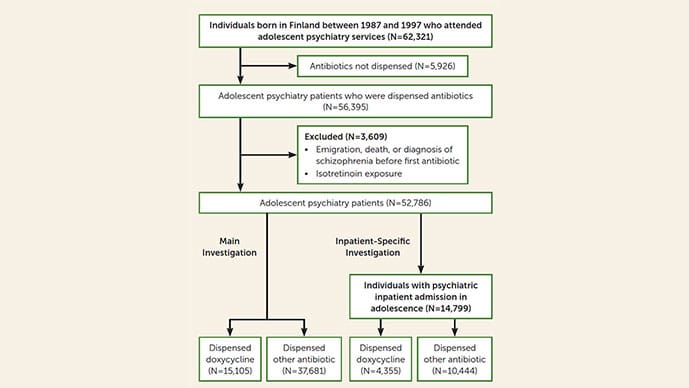 Of that population, the researchers restricted the analysis to those who had received at least one prescription for any antibiotic. I like this choice. Comparing those who took doxycycline just to those who did not would potentially lead to some bias. People who take doxycycline might have better access to care or are more likely to have infections, for example. An active comparator — a different antibiotic — is a good design choice here.
All told, we’re talking about 52,786 adolescents, about one third of whom had a prescription for doxycycline (median total dose, 1500 mg; or about two weeks of therapy), and the rest had a prescription for a different antibiotic.
Those who received doxycycline were quite different at baseline from those who did not. They were more likely to be female, older at cohort entry, and more likely to have mood disorders. These factors were statistically accounted for in the primary analysis.
And after all that, here are the primary results.
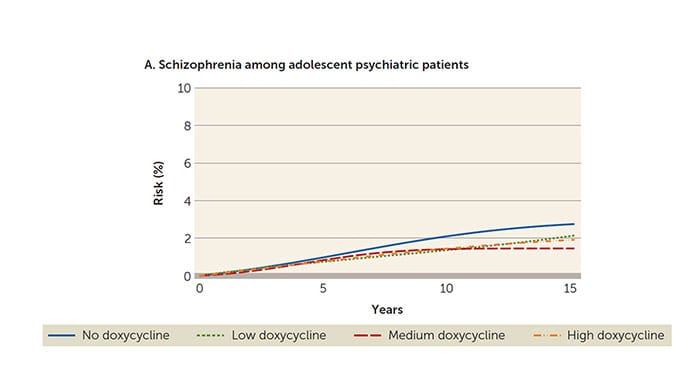
Over 15 years, the risk of developing schizophrenia was 2.74% among the kids who had not received doxycycline. Among those who had low exposure, the risk was 2.22%, at medium exposure (up to 3000 mgs) 1.42%, and at the highest dose (above 3000 mg total), 2.0%.
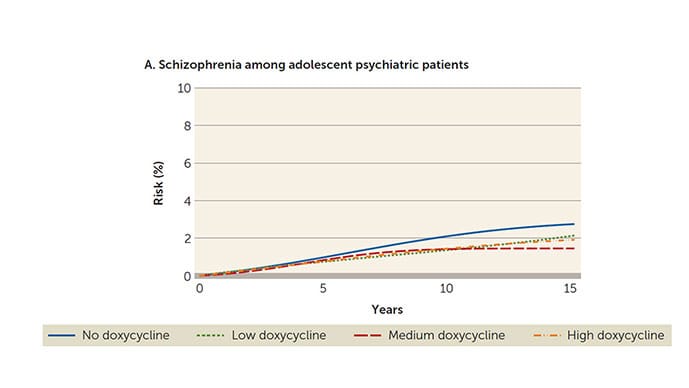 On the relative scale, we’re talking about a 20%-50% reduction in schizophrenia cases, so this is nothing to sneeze at.
The effect was a bit more noticeable when they restricted the analysis to kids who had required inpatient psychiatric services — a much higher risk group.
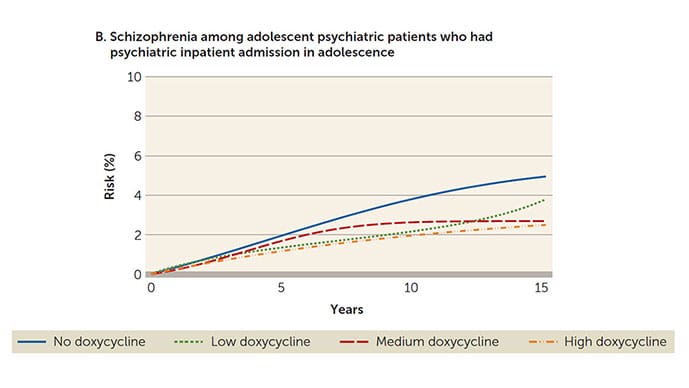 If this were a causal effect, it would be the first preventive treatment for schizophrenia. It would also be a cheap, widely available, and relatively low-risk preventive treatment for schizophrenia. That’s a big deal.
But is it causal?
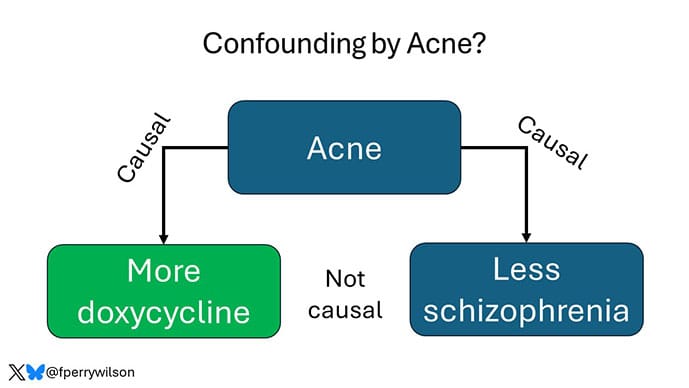
The researchers do a nice job of taking some of the common biases off the table here. The major confounder here is probably acne, since that’s the primary reason adolescents would be prescribed doxycycline. But they repeated their analysis using non-tetracycline acne drugs and found no protective effects for schizophrenia, suggesting that it isn’t acne or treatment of acne that is the actual protective thing here.
 This isn’t a randomized trial, so you do have to worry about unaccounted-for differences in the treatment groups that would make the doxycycline group healthier overall. To evaluate that, they performed a negative control analysis, looking to see whether doxycycline had any effect on preventing anorexia nervosa. No signal there. So far so good.
But I still have my doubts. First of all, there is really no evidence of a dose-response effect here. Higher doses having stronger effects is not a universal marker of causation, but it helps when it is there.
 The second issue I have depends on that design choice I highlighted earlier — restricting the analysis to kids who had interaction with psychiatric services. This, to me, is a ripe setup for a particular problem called collider bias. It works like this.
Imagine for a moment that doxycycline, in reality, has no effect on schizophrenia one way or the other. But that doxycycline does increase the risk of requiring psychiatric care, maybe by causing mild depression in some kids. I’m not saying this is true, by the way, I am just illustrating how this interesting bias can work.
Now we take a population of kids, some of whom took doxycycline and others who didn’t. Some of those who got doxycycline became slightly more depressed than they otherwise would have been. Some, who were on the edge of needing psychiatric care, but not quite there yet, get pushed over that edge. Now they are part of the “kids who got psychiatric care” group. But realize that these will actually be the healthiest kids in that group. Had it not been for the doxycycline, they wouldn’t have needed psychiatric care at all, after all.
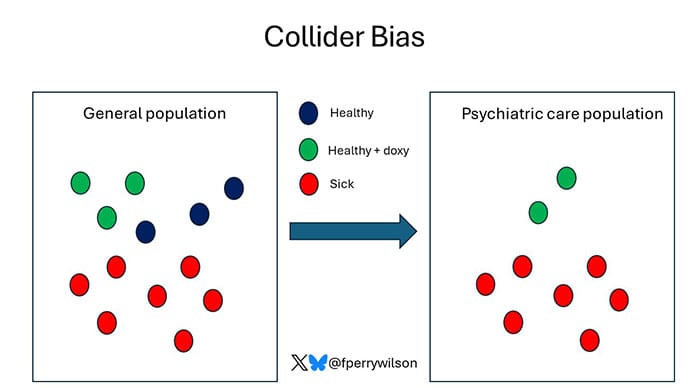 Now, restricting our analysis to the group who got psychiatric care, those who got doxycycline look great by comparison. You conclude that doxycycline is protective when in fact it is not. Collider bias. It’s a sneaky one.
To be fair, if this were driving all the results, I’d expect other outcomes (such as anorexia) to look better in the doxycycline group. But a really easy check on this would be to do an analysis where you only include kids who got their first dose of antibiotic after they started psychiatric care. The authors presumably have this data, but it isn’t reported.
Given the incredible risk associated with schizophrenia, any hope for prevention should not be dismissed. This study is promising, and I hope it inspires more investigations into neuro-protective measures for at-risk kids. Can it be right? At the beginning, I didn’t think so. I’m still fairly dubious, but sometimes important discoveries are hiding in plain sight, so I will remain hopeful, await some replication, and cross my fingers for a real randomized trial.
F. Perry Wilson, MD, MSCE, is an associate professor of medicine and public health and director of Yale’s Clinical and Translational Research Accelerator. His science communication work can be found in the Huffington Post, on NPR, and here on Medscape. He posts at @fperrywilsonand his book, “ How Medicine Works and When It Doesn’t”, is available now.